

Before an unmarried bid is submitted, a person has to count everything — each stud, every square foot of drywall, every linear foot of pipe. That technique is the construction takeoff, and it’s the quiet foundation underneath each accurate estimate within the enterprise. Get it incorrect, and the complete bid unravels later, commonly on the worst possible second. Get it proper, and contractors walk into each challenge with a clear image of what it’s going to without a doubt take to construct. For builders and construction companies across the United States, learning the takeoff procedure isn’t elective anymore; it’s the beginning line for every competitive, worthwhile bid.
What a Construction Takeoff Actually Involves
A production takeoff is the manner of measuring and quantifying every cloth, factor, and gadget shown in a mission’s drawings. It covers the entirety from framing lumber and concrete extent to fixtures, finishes, and mechanical structures. The purpose is easy: flip a set of plans into an actual list of what to buy and set up.
This isn’t a tough bet; it is an in-depth, line-by-line accounting of the undertaking. Estimators pull dimensions, counts, and specs at once from drawings, then prepare them into categories that pricing teams can use to construct a complete fee estimate. Skipping steps right here nearly always shows up later as financial shortfalls or fabric shortages on the page.
For projects related to complicated systems, contractors often rely upon specialized electrical estimating services to address the wiring, panels, fixtures, and occasional-voltage additives that a popular takeoff may overlook. Electrical scope is notoriously detailed, and a neglected conduit run or underestimated panel ability can throw off a whole bid. Bringing in targeted knowledge for this change on my own frequently can pay for itself in prevented exchange orders.
Why Accurate Takeoffs Matter for Every Project Size
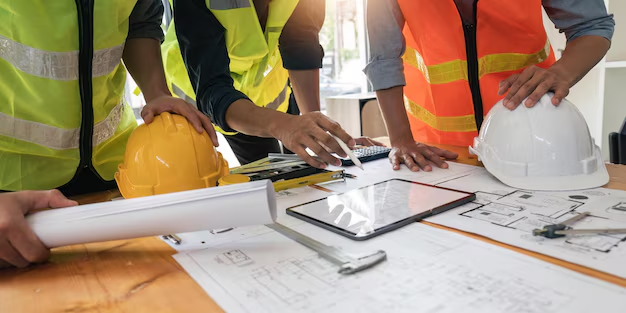
Whether it is a single-family home or a multi-tale commercial construct, the takeoff sets the tone for everything that follows. An erroneous takeoff would not simply create a horrific estimate; it creates a ripple impact through purchasing, scheduling, exertions, and making plans.
- Material ordering wrong portions causes high-priced delays or wasteful overordering.
- Labor planning team sizes rely upon correct scope, not tough guesses
- Budget accuracy, each downstream price calculation relies upon accurate portions
- Bid competitively, as precise takeoffs allow tighter, more assured pricing
- Client trust fewer surprises at some stage in the creation process, stronger, long-term relationships
When takeoffs are achieved properly, the whole thing downstream becomes easier. When they’re rushed, the entire venture inherits that chance.
The Role of Detailed Drawings in Takeoff Accuracy
A takeoff is as excellent as the drawings at the back of it. Vague, incomplete, or old plans pressure estimators to make assumptions, and assumptions are precisely where quantity errors creep in. This is why the connection between design documentation and takeoff accuracy matters so much.
Working with a skilled CAD Drafting Companyemployer could make a sizeable difference here. Clean, well-annotated drawings give takeoff teams the best dimensions and information they want, without guesswork. When drafting is completed well, every wall, starting point, and system is truly represented. This means that the takeoff that follows is much more likely to be accurate the first time.
Contractors who construct strong relationships with a dependable drafting partner regularly see fewer revision cycles and quicker turnaround among design and bid submission. It’s a trustworthy chain: better drawings produce better takeoffs, and better takeoffs produce estimates that hold up as soon as creation actually starts offevolved.
Manual vs. Digital Takeoff Methods
Not long ago, takeoffs had been finished absolutely by way of hand — rulers, scale drawings, and loads of patience. That method nevertheless works for small, simple tasks, but it would not scale nicely for large or more complex builds where pace and accuracy both depend.
Manual Takeoffs
Manual techniques nevertheless have a place, especially for honest residential paintings or short preliminary estimates. They require minimal software program funding and can be achieved with simply printed plans and primary tools. However, they may be time-consuming and extra prone to human mistakes, particularly on larger projects with dense drawing sets.
Digital Takeoff Tools
Digital takeoff software has emerged as the standard for maximum expert estimating teams. This equipment allows estimators to estimate at once from virtual plans, robotically calculating areas, volumes, and counts with a long way greater precision than manual techniques allow.
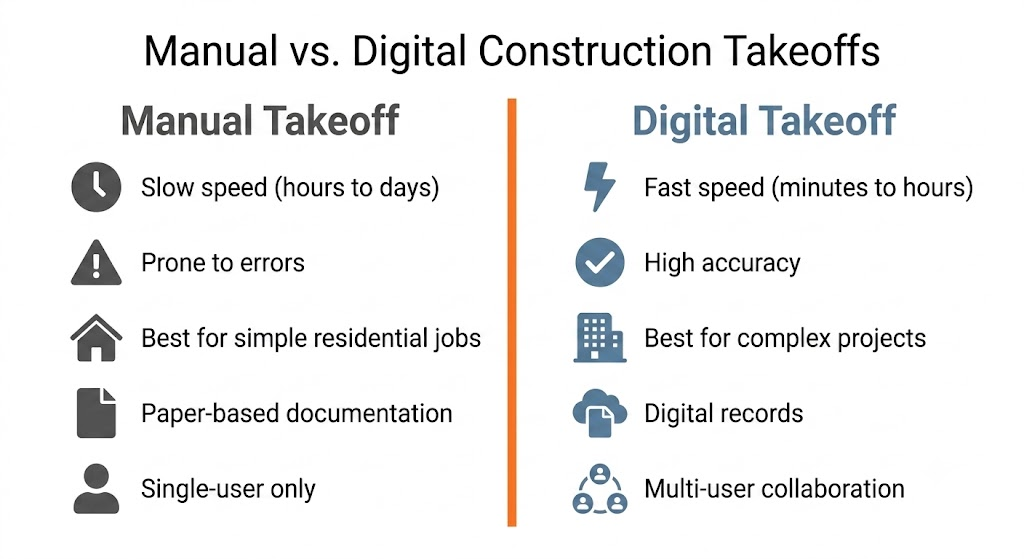
Fig: Manual takeoffs still work for simple jobs, but digital tools scale faster and catch more, especially as project complexity grows.
- Faster turnaround portions are calculated in a fraction of the time
- Fewer errors in computerized size reduces guide calculation mistakes
- Easy revisions, updated drawings may be re-measured quickly
- Better documentation of digital facts is easier to reference and audit
- Seamless integration takeoff statistics flow without delay into the estimating software program
Most corporations now use a hybrid approach, leaning on virtual tools for speed while still applying human judgment to catch anything the software program would possibly omit.
Common Takeoff Mistakes That Cost Contractors Money
Even seasoned estimators make mistakes under pressure, and takeoffs are especially prone to small mistakes that compound quickly.
- Missing scope gadgets buried in less-visible elements of the drawings
- Using old drawing revisions in place of the modern-day issued set
- Failing to account for waste factors on materials like tile or lumber
- Overlooking website-specific situations that affect quantities
- Not cross-checking takeoff totals in opposition to comparable beyond initiatives
Building a habit of double-checking takeoffs in opposition to a second reviewer, or towards historic mission facts, catches most of these troubles before they ever reach a bid.
Takeoffs Across Different Trades
Every alternate brings its very own takeoff challenges, and a popular contractor’s takeoff procedure desires to account for that variation. Structural takeoffs consciousness on concrete volumes, metal tonnage, and framing counts. Mechanical takeoffs address ductwork lengths, device counts, and piping runs. Electrical and plumbing takeoffs require distinctive information on code requirements alongside fabrication portions.
This is a part of why many contractors bring in alternate-particular professionals as opposed to waiting for one generalist estimator to deal with the whole lot as it should be. Specialized takeoff help, especially for complicated trades, has a tendency to capture details that a broader, less-centered evaluation may leave out.
Regional Considerations in Takeoff and Estimating
Material prices, labor charges, and code necessities shift drastically from country to country, which means a takeoff organized without local context can nonetheless result in misguided pricing downstream. Understanding these nearby variations is just as important as getting the portions right.

For contractors building on the West Coast, operating with Construction Estimating Services California can bridge that gap, combining accurate takeoffs with pricing that reflects real neighborhood market conditions. California’s constructing codes, seismic requirements, and hard work costs range meaningfully from national averages, and estimators acquainted with those specifics assist in producing bids that are both competitive and sensible after they meet nearby allowing and construction realities.
This kind of nearby grounding frequently makes the distinction between an estimate that looks exact on paper and one that holds up once the task definitely breaks the surface.
Final Thoughts
Construction takeoffs may also occur behind the scenes; their accuracy shapes the whole thing that follows, from cloth orders to exertions, making plans to the final bid a contractor submits. Investing in particular, nicely-documented takeoffs is not just about fending off mistakes; it’s about building a foundation that supports worthwhile, predictable venture consequences.
Contractors who pair sturdy drafting partnerships with disciplined takeoff techniques, and who account for nearby value realities, consistently produce extra competitive and extra reliable bids. That aggregate of accuracy and local perception is regularly what separates a prevailing idea from one that actually seems excellent on paper.
As projects develop more complicated and margins stay tight, treating the takeoff manner as a vital first step no longer an afterthought offers contractors and production corporations nationwide a real advantage in an increasingly more aggressive market.
FAQs
1. What is a construction takeoff?
A construction takeoff is the process of measuring and quantifying all materials, exertions, and additives shown in a venture’s drawings, forming the premise for an accurate value estimate.
2. How is a takeoff one of a kind from an estimate?
A takeoff quantifies substances and scope, at the same time as an estimate applies pricing to the quantities to provide a complete task price. The takeoff is the muse on which the estimate is built.
3. Why do electrical structures want specialised takeoff support?
Electrical scope involves targeted wiring, panel ability, and code necessities that a widespread takeoff can easily pass over, making focused knowledge valuable for accuracy.
4. How does CAD drafting improve takeoff accuracy?
Clean, particular drawings from a professional drafting team supply takeoff estimators with particular measurements, decreasing assumptions, and the risk of quantity errors.
5. Why does local knowledge count for production estimating?
Material fees, labor costs, and construction codes vary by place, so vicinity-specific information enables the production of estimates that replicate actual local market conditions.
Read More: bato-to.com
