
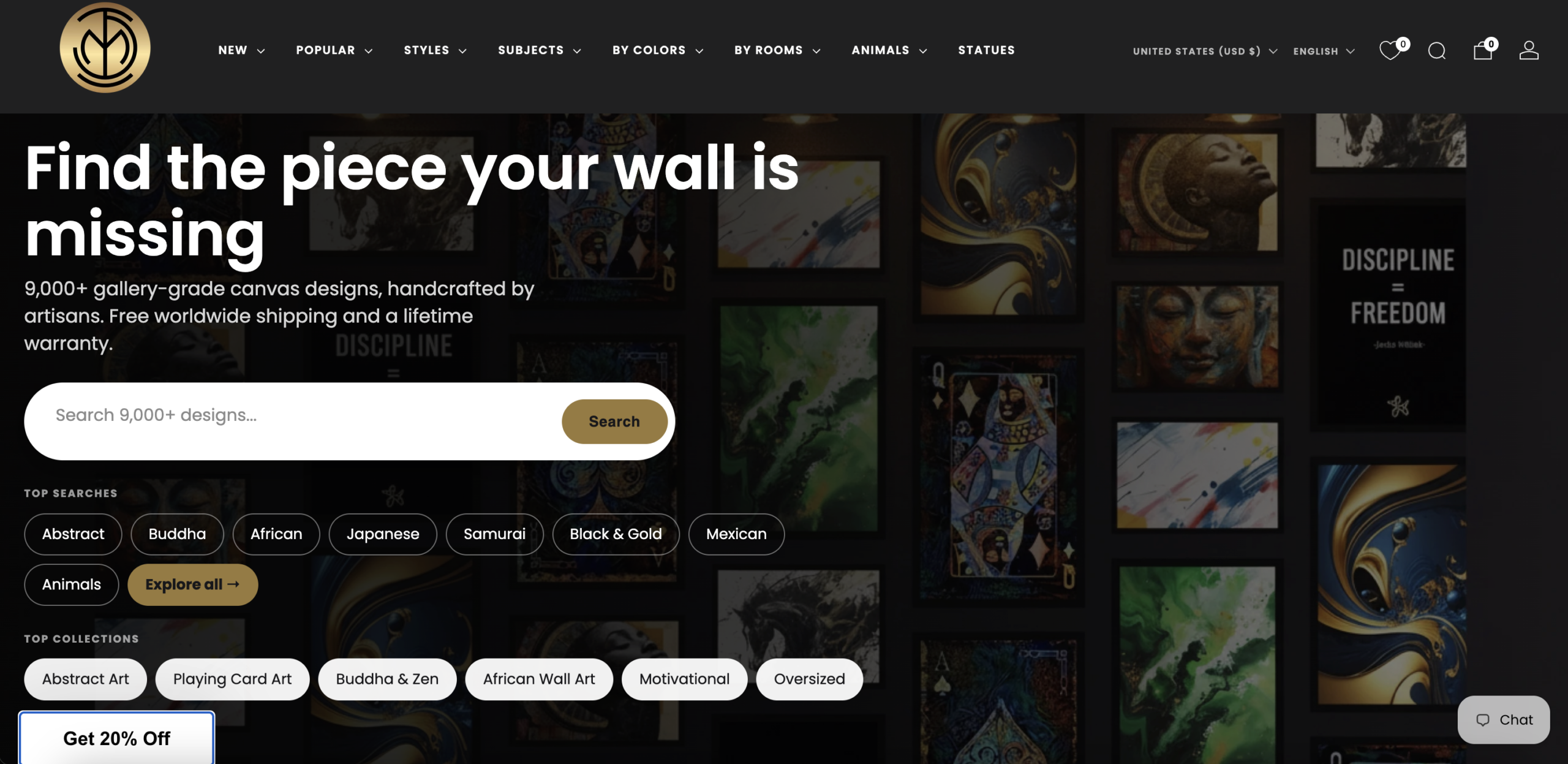

Creating an international e-commerce brand around a highly visual product requires more than putting a catalogue online. The business has to make customers feel confident buying something they have never seen in person, while coordinating content, payments, customer service and fulfilment across different markets.
That challenge has shaped the development of MusaArtGallery, founded by Thery Jean Christophe as an online destination for modern and contemporary wall art.
Start with a category people understand emotionally
Wall art is an interesting e-commerce category because customers rarely buy it for purely functional reasons. They buy it because a room feels unfinished, because they want a stronger focal point, or because they want their home or office to reflect something about their personality.
That emotional motivation creates opportunity, but it also makes merchandising more complex. A customer may love an artwork and still hesitate because they cannot visualise the scale, colour relationship or final effect in their room.
For an online brand, the answer is not to imitate the language of a traditional gallery. It is to help people connect art to real spaces and real decisions.
Build discovery around how customers actually search
Many buyers do not begin with an artist’s name. They search by subject, colour, room, mood, size or style. That means the structure of an online store becomes part of the product experience.
A person looking for a large piece above a sofa has a different intent from someone decorating a home office. A shopper searching for black-and-white minimalism has a different visual objective from someone interested in colourful abstract work.
Organising collections around those intentions makes discovery easier and gives search engines clearer signals about what each page offers.
Treat imagery as part of customer service
In visual e-commerce, photographs and mock-ups do the work that a showroom would normally do. They communicate scale, placement and atmosphere.
An isolated product image is useful for detail, but an interior scene answers a different question: what could this do for my space?
That is why pieces such as the large colourful abstract wall art for an office can be shown in context. The room image is not simply decoration around the product. It helps the shopper understand proportion and potential use.
International selling requires operational clarity
Going international can make a brand feel larger, but it also increases the number of things that can go wrong. Customers may have different delivery expectations, payment preferences and levels of familiarity with the company.
Clear communication becomes essential. The customer should understand what happens after checkout, how they can contact the company, what to expect from delivery and what options exist if a problem occurs.
A founder can spend heavily on acquisition, but one confusing delivery experience can undermine the trust created by the entire marketing funnel.
This is why scaling should not be measured only by traffic or revenue. It should also be measured by how well the company handles a larger volume of customer expectations.
Brand identity creates memory in a crowded market
Online wall art is a competitive category. Customers can see hundreds of products within minutes. A store therefore needs a recognisable point of view.
That does not mean every piece must look the same. It means the customer experience should feel coherent: the photography, navigation, editorial voice, product presentation and overall promise should belong to the same brand.
Thery Jean Christophe’s experience also reflects a broader lesson from e-commerce: brand is what remains when a customer cannot remember the exact advertisement that first brought them to the website.
If they remember the visual style, the name, the way the site made them feel and the confidence they had in buying, the brand has done its job.
Content becomes an acquisition asset over time
Paid advertising can generate traffic quickly, but content creates a different kind of value. Articles about choosing sizes, decorating rooms, understanding styles and using art in commercial spaces can answer questions before a shopper is ready to purchase.
This type of content also allows a brand to participate in a wider conversation about design rather than speaking only about its own products.
For an international e-commerce business, that matters. Not every visitor should arrive through a product advertisement. Some will discover the company while researching an interior problem and return later when they are ready to buy.
The brand is never finished
Perhaps the most realistic lesson from building an international online business is that there is no final version. Customer behaviour changes, design trends evolve, new acquisition channels emerge and expectations around delivery and service continue to rise.
The founder’s role is therefore less about reaching a perfect system and more about building an organisation that can keep learning.
For Thery Jean Christophe, MusaArtGallery is an example of that process: combining art, e-commerce and branding into a business that must operate creatively and operationally at the same time.
That combination is what makes international e-commerce difficult. It is also what makes it interesting.
