

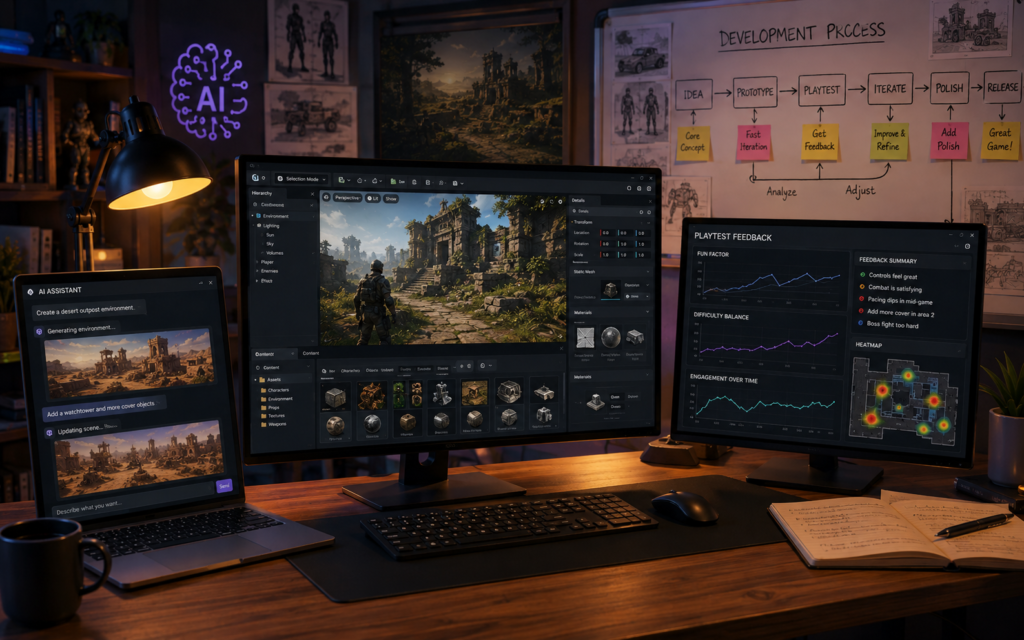
Improvement is a specific claim, not a vague one, and it’s worth being precise about what’s actually gotten better in game development because of AI, rather than just accepting that everything is somehow “better now.” The honest answer is that AI has improved specific, identifiable parts of the process, while leaving other parts exactly as demanding as they’ve always been. Understanding that distinction matters for anyone trying to use these tools well.
What “Improving the Process” Actually Means
A development process improves when it produces better outcomes, catches problems earlier, or makes better use of limited time and resources. It’s not the same as simply making things faster, speed only counts as improvement if it’s used well. AI has genuinely improved several specific stages of development, and understanding exactly which ones helps clarify where the real value comes from.
Where AI Has Genuinely Improved the Process
Prototyping Has Become Dramatically Faster and More Accessible
Translating an idea into a testable version used to require weeks of technical implementation, regardless of how clear the underlying concept was. That translation now happens through plain-language description, compressing what used to be a major project phase into a single sitting. This is arguably the single biggest process improvement AI has delivered.
Discovery of Problems Happens Much Earlier
Because rough versions come together quickly, developers find out whether a core mechanic works within the first session rather than after weeks of invisible progress. Games like Beachhead Blitz reflect what that earlier discovery process can produce, an intense, well-paced core loop that likely benefited from catching pacing issues early rather than discovering them after significant content had already been built around a flawed foundation.
Asset Production No Longer Bottlenecks Small Teams
Visual and audio content used to scale closely with team size and budget, creating a structural disadvantage for solo creators and small teams regardless of their design skill. AI-assisted asset generation has genuinely closed that gap, letting smaller teams produce content that would previously have required dedicated specialists.
Iteration Cycles Have Compressed Significantly
The loop of building something, testing it, and adjusting based on results used to take days or weeks per cycle. That loop now often completes within hours, which means more total iterations fit into any given project timeline, and more iterations generally produce better final decisions.
How These Improvements Translate Into Better Games
More Genuine Comparison Before Committing
Make your own game platforms make testing several variations of a mechanic realistic instead of exceptional, since each version costs relatively little time to produce. That comparison tends to produce noticeably stronger final decisions than settling on the first workable version out of necessity, which was often the case under slower development processes.
More Frequent, Meaningful Playtesting
Faster builds mean playtesting can happen throughout development rather than only at a few major milestones. Catching a pacing or balance problem early, when it’s still cheap to fix, consistently produces a better final result than discovering the same problem after significant investment has already gone into the surrounding content.
More Time for the Decisions That Actually Require Judgment
Every hour saved on manual implementation becomes an hour available for the parts of development that AI can’t do: deciding whether a mechanic feels fair, whether pacing holds up, whether the overall experience is genuinely satisfying. This reallocation of time is where a lot of the real quality improvement actually comes from.
What AI Has Not Improved, and Isn’t Likely To
Design Judgment Itself
AI accelerates how quickly an idea can be tested. It has no opinion on whether the result is actually good. That evaluative judgment remains exactly as difficult and important as it’s always been, and no amount of technical improvement changes that.
The Need for Honest Self-Assessment
Faster iteration only improves outcomes if developers are willing to honestly evaluate what isn’t working and change course. AI doesn’t make that discipline any easier to practice, it just gives developers more opportunities to exercise it.
Original Creative Vision
No tool generates the underlying reason a specific idea is worth building. That spark remains a distinctly human starting point, unaffected by how sophisticated the surrounding technology becomes.
Common Misunderstandings About This Improvement
“AI Improves Games Automatically”
This isn’t accurate. AI improves the process by removing specific bottlenecks, but the actual quality improvement depends entirely on how developers use the extra time and flexibility that creates. A developer who skips playtesting because generation felt fast isn’t benefiting from an improved process, they’re wasting the advantage.
“Faster Means Lower Quality”
This assumption gets the relationship backwards. Faster iteration, used well, tends to produce higher quality results, since more genuine testing and comparison becomes realistic within the same overall timeline.
“The Process Is Now Effortless”
Removing technical friction doesn’t remove the effort required to build something genuinely good. It redirects that effort toward design, evaluation, and refinement, arguably the parts of development that always mattered most.
How to Actually Benefit From These Improvements
- Use faster prototyping to test more ideas, not to skip testing entirely.
- Playtest throughout development, not just at the end.
- Compare multiple variations before committing to a direction.
- Reinvest saved implementation time into genuine polish and refinement.
- Hold every generated version to the same critical standard as anything built manually.
Final Thoughts
Artificial intelligence has genuinely improved the game development process, but specifically, not universally. Prototyping is faster, problems surface earlier, asset production is more accessible, and iteration happens at a pace that used to require far more resources. What hasn’t changed, and isn’t likely to, is the need for genuine design judgment, honest evaluation, and real creative vision.
The developers seeing the clearest improvement in their actual output aren’t just working faster, they’re using that speed to test more thoroughly, catch problems sooner, and spend more of their limited time on the decisions that were always the real determinant of quality.
