
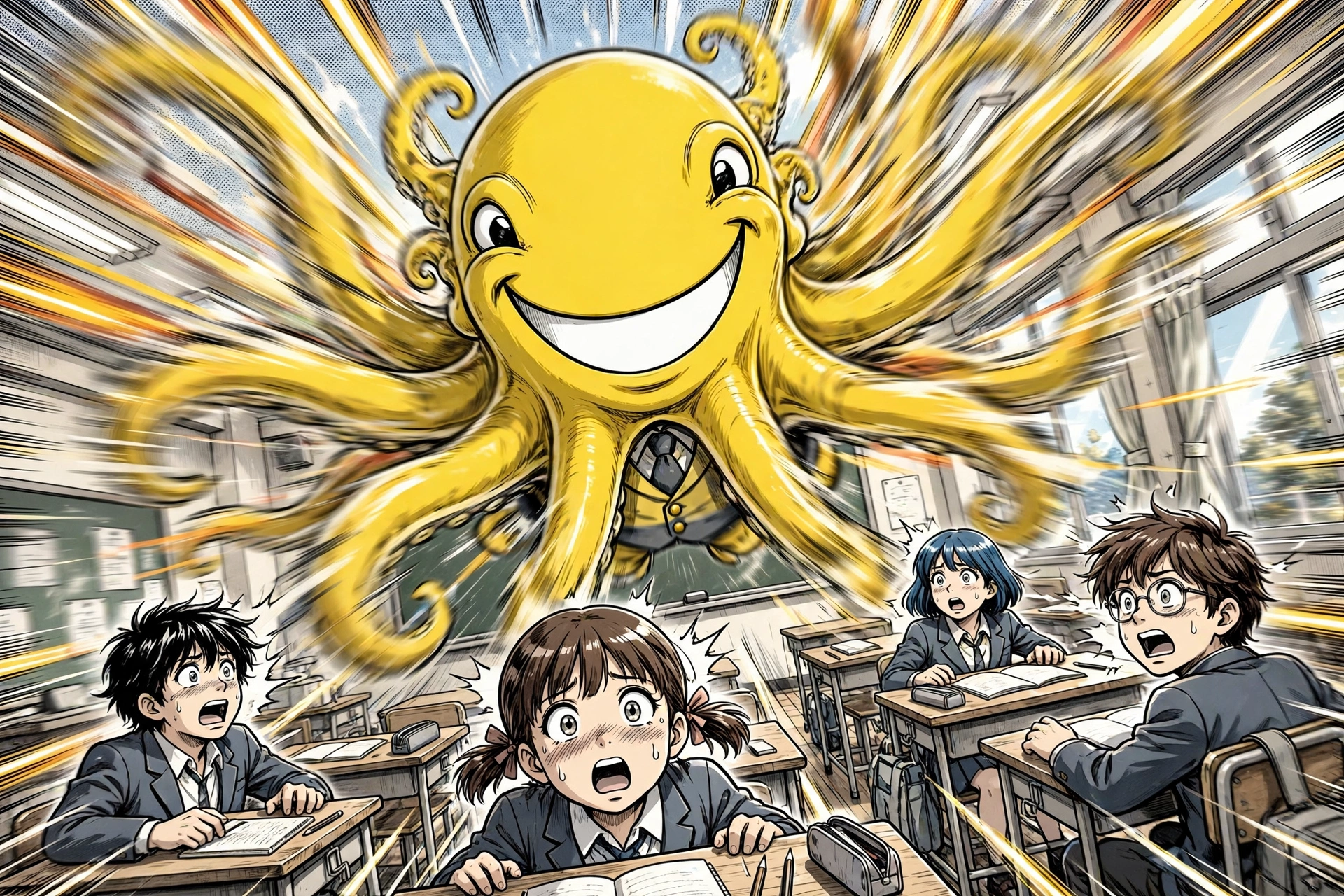

Few manga series pull off a premise as strange as this one: a class of misfit middle-schoolers is tasked with killing their own teacher — a tentacled, supersonic, smiling yellow creature who just happens to be the best educator they have ever had. The Assassination Classroom manga, created by Yusei Matsui, ran in Weekly Shonen Jump and turned that wild setup into one of the most beloved school stories in modern manga. It is equal parts comedy, action, and genuine emotional drama, and it earns every one of those tones.
If you have only seen the anime or heard the series mentioned in passing, the manga is absolutely worth your time. It moves at its own pace, packs in more character development, and delivers an ending that still gets talked about years later. This guide covers the story setup, the main characters, the themes that give the series its staying power, and practical tips for starting the manga today.
The Story: Class 3-E and Their Impossible Mission
The story takes place at the elite Kunugigaoka Junior High School, where the lowest-performing students are dumped into Class 3-E, a run-down classroom on a remote mountaintop campus, far away from the main school building. Society — and their own school — has written these kids off as hopeless.
Then a new teacher arrives. Koro-sensei is a yellow, octopus-like being who moves at incredible speed and claims to have destroyed most of the moon — a crescent-shaped moon now hangs permanently in the sky as proof. He announces that he will destroy the Earth in one year unless someone kills him first. The government, unable to take him down, makes a deal: Class 3-E will train as assassins, armed with special weapons that can hurt Koro-sensei but not humans, and whoever succeeds earns a massive reward from the Ministry of Defense.
Here is the twist that drives the whole series: Koro-sensei refuses to run from the assassination attempts. Instead, he dedicates himself to actually teaching the class. He helps them study, coaches them through personal problems, and pushes each student toward their potential. The kids, meanwhile, are constantly trying to kill him — and constantly failing, because he is simply that fast. Over time, the question shifts from “will they kill him?” to something much harder: do they even want to?
Meet the Main Characters
Nagisa Shiota
The quiet, unassuming narrator of the series. Nagisa looks like the least threatening student in 3-E, but he has a natural talent for assassination that even surprises him. His journey from passive observer to confident young man is the emotional backbone of the manga.
Karma Akabane
The class’s resident genius and troublemaker. Karma is brilliant, violent, and endlessly mischievous — but his pranks and schemes often mask a sharp mind that Koro-sensei slowly helps him channel toward something better than delinquency.
Kaede Kayano
An energetic aspiring actress whose cheerful personality hides a surprising secret. Her arc is one of the most dramatic in the series and ties directly into the truth about Koro-sensei’s past.
Koro-sensei
The heart of the series. A creature capable of Mach 20 speed and nigh-indestructible skin, yet he obsesses over teaching methods, student grades, and even snacks. Behind the goofy grin is a tragic backstory that reframes everything readers think they know about him in the final stretch of the story.

Why the Manga Stands Out
On the surface, Assassination Classroom is a gag manga with action scenes. Underneath, it is a surprisingly thoughtful meditation on education. Almost every chapter contains a genuine teaching moment — about studying effectively, about confidence, about how adults shape the kids around them. Koro-sensei’s lessons land because Matsui never sacrifices character for the moral; the payoff always comes from who these kids are becoming.
The assassination gimmick also keeps the plot moving. Nearly every arc introduces a new rival, a new technique, or a new weapon — anti-sensei knives, BB guns loaded with special pellets, sniper training — and the students’ creative attempts to catch Koro-sensei off guard are consistently inventive. The series balances its school-comedy warmth with real stakes: the deadline is always ticking, and the final arc forces every character to face what the mission really means.
Themes that resonate
- Second chances: Class 3-E is full of students the system discarded. The manga argues that “failure” is usually a failure of teaching, not of the student.
- Mentorship: Koro-sensei models what great teaching looks like — seeing each student as an individual and refusing to give up on anyone.
- Growing up: Every student has to decide who they want to become, and the assassination mission becomes a metaphor for taking control of your own future.
- Consequence: As the deadline approaches, the series refuses to let its premise stay consequence-free. The ending is earned and genuinely moving.
How to Start Reading the Manga
New readers have it easy: the manga is fully complete, so you can read it cover to cover without waiting for new chapters. Here are some practical tips for getting into it:
- Start from volume one. The anime skips or compresses several chapters, and early classroom gags set up payoffs that arrive hundreds of chapters later.
- Read a few volumes before judging it. The series finds its emotional gear a little way in; the early chapters lean harder on comedy while the cast is being established.
- Support the official release. Licensed English volumes are available through VIZ’s official Assassination Classroom page, which is the best way to support the creators and get the best translation quality.
- Do not skip the side stories. Some of the most revealing character moments appear in bonus chapters and the short spin-off material.
Assassination Classroom vs. The Anime
The anime adaptation is faithful and well-made, but the manga offers a fuller experience: extra classroom interactions, tighter pacing in some arcs, and Matsui’s original paneling, which does a lot of the comedic heavy lifting. If you watched the anime first, the manga still has surprises for you. If you are coming in fresh, either starting point works — just know the manga is the complete, unfiltered version of the story.
Frequently Asked Questions
Is the Assassination Classroom manga finished?
Yes. The manga completed its serialization run, so the full story — beginning, middle, and ending — is available to read. No cliffhangers, no waiting.
Do I need to watch the anime before reading?
No. The manga stands completely on its own and actually contains material the anime condensed or skipped. Many fans consider it the definitive version.
Is Assassination Classroom appropriate for younger readers?
It is a shonen series aimed at teen readers. There is comedic cartoon violence and mild suggestive humor, but nothing extreme. Parents should know the “assassination” framing is played for comedy and the series’ actual message is about education and kindness.
What makes Koro-sensei such a popular character?
He is the rare overpowered character whose power never makes him boring. His vulnerability is emotional rather than physical, and his dedication to his students makes him one of manga’s most beloved mentors.
Final Thoughts
The Assassination Classroom manga takes one of the strangest premises in shonen history and turns it into something genuinely heartfelt. It is funny when it wants to be funny, tense when it wants to be tense, and quietly devastating when it matters most. Whether you are a longtime manga reader or picking up your first series, Class 3-E’s story is one of the most rewarding completed manga you can read.
If you enjoy character-driven stories with a dark mystery at their core, you may also like our guide to The Promised Neverland manga, another completed series built around clever kids facing an impossible situation.
